Development That Respects History
Development that respects the Hotel's history is a fundamental principle behind every improvement made to the building. With this in mind, providing modern comfort within a structure dating from 1882, exposed to the harshness of the high-altitude climate, is a fascinating challenge.
Hydroelectric Plant and Drinking Water Supply
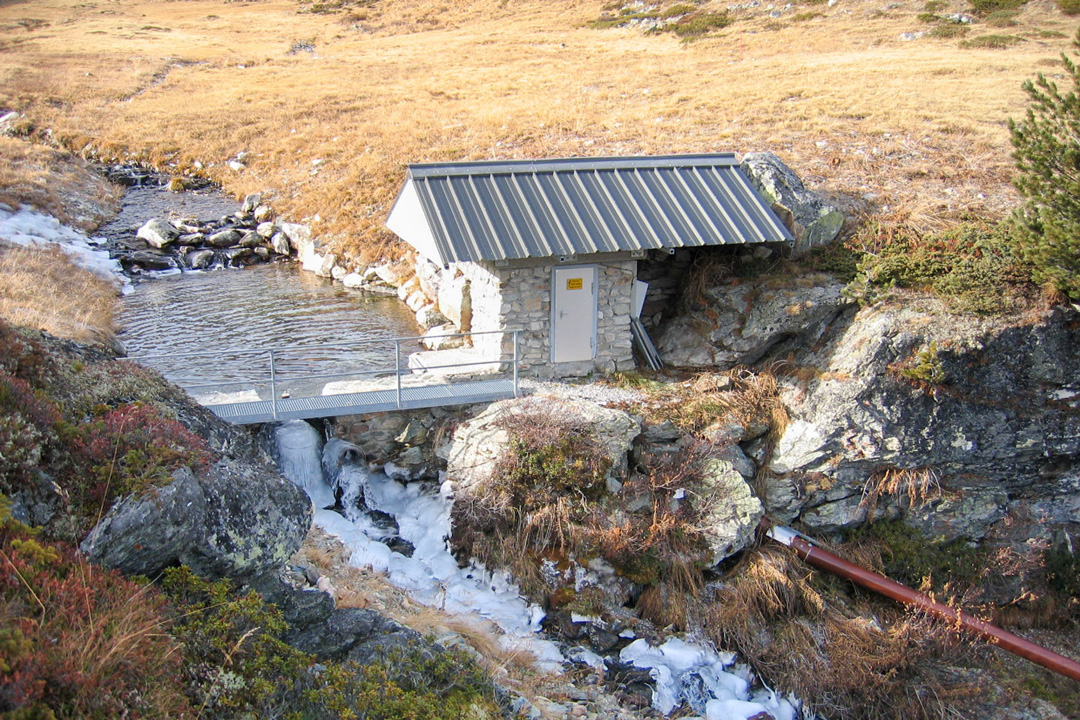
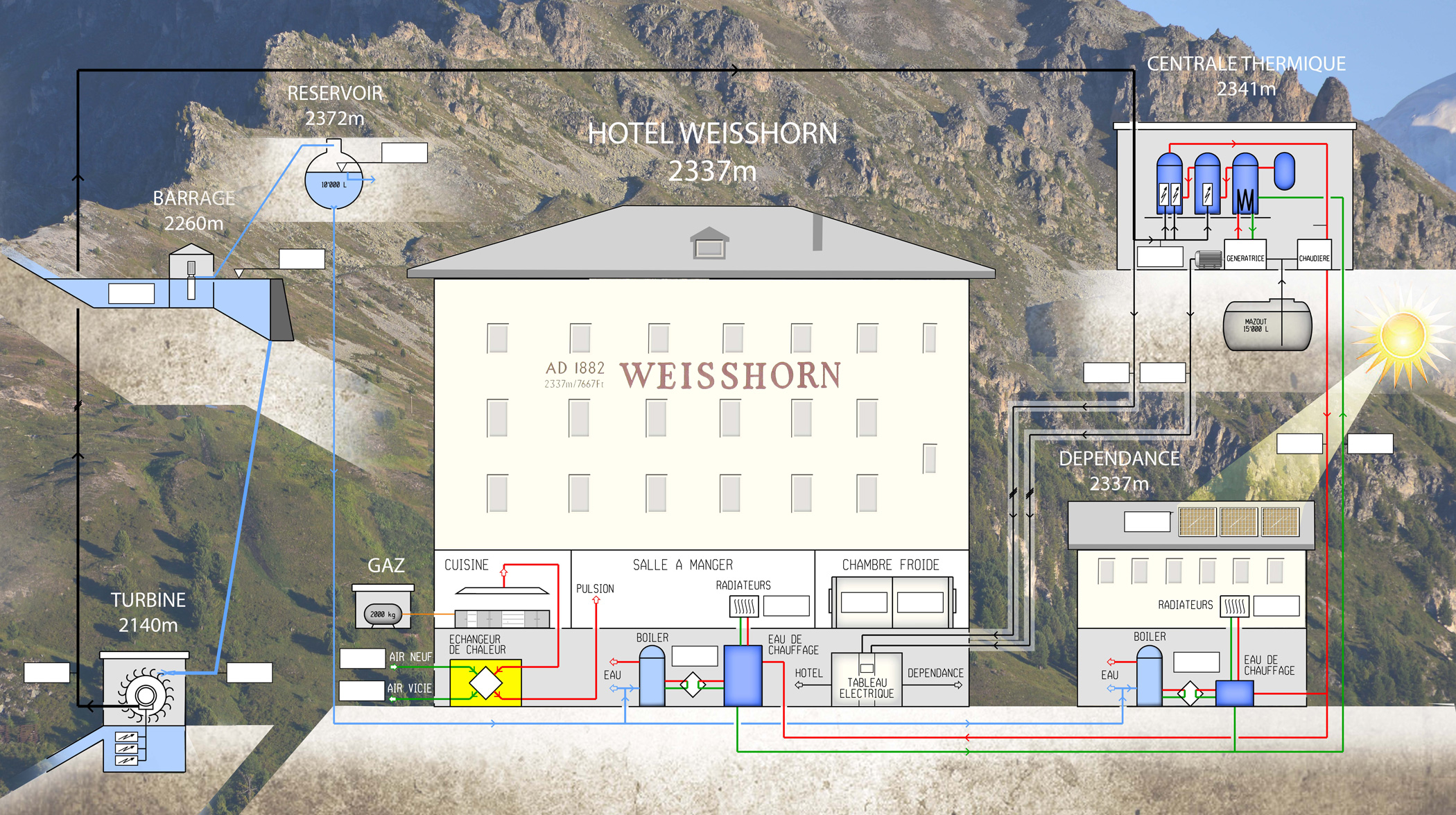
Hotel Weisshorn operates off-grid, generating its own electricity. Except in winter, all of its energy comes from a hydroelectric plant (2,140 m) delivering up to 30 kW of electrical power. The water comes from the Moulins stream. Held back by a small dam (2,260 m), it passes through a trash rack before reaching a surge chamber, from which a penstock (diameter: 145 mm, length: 300 m) descends. This pipeline carries a flow of 30 l/s over a drop of 120 m, feeding a vertical-axis Pelton turbine fitted with six nozzles, four of which can be modulated according to the available water resource. The three-phase output voltage of the turbine (400 V) is stepped up to 1,000 V to reduce transmission losses on the way to the hotel, where it is then stepped back down to 400 V. The electrical cable runs entirely underground. A control panel distributes the power through a distribution board, dividing the building into three circuits: kitchen, laundry, and lighting/sockets. Rising consumption, particularly from the laundry (two washing machines, a drying room with dehumidifier, and a mangle), has brought a significant gain in comfort and efficiency. The hotel's first hydroelectric machine, believed to have been installed in 1902, has since been replaced twice — first in 1970, then again in 2002 — each renewal responding to growing electricity needs. Energy not consumed by appliances and lighting is diverted to the heating circuit. Three 10 kW electric heating elements warm a total of 10,000 l of water. This closed circuit supplies the buildings with heat and domestic hot water. In the event of a power surplus, three additional 10 kW safety heating elements dissipate the excess directly at the turbine. This rarely happens, mainly during the shoulder seasons or in case of a fault in the power line or transformer. Drinking water also comes from the Moulins stream. An electric multistage pump fitted with a strainer, installed at the dam, feeds a 12 m³ tank (2,372 m) located 660 m away and 112 m higher, on a rocky outcrop above the hotel. This tank allows sediment to settle naturally and is cleaned regularly. Pumping runs continuously to prevent the pipes exposed to permafrost from freezing. The water then flows by gravity down to the hotel (2,337 m), where it is filtered and treated with UV light. This treatment ensures the sanitary quality of this mountain water at all times.
Visit the turbine and the water reservoir by clicking here.
The Challenge of Winter Cold
In winter, the reduced water flow (down to 10 l/s) cuts electricity production by a factor of three. To compensate, a 40 kW diesel generator is used periodically, mainly for the kitchen and laundry. It prevents voltage and frequency drops that could otherwise cause the grid to fail. Heat given off by the diesel engine is partly recovered through the cooling circuit, which preheats the heating circuit on its return from the buildings. Three 10 kW regulators continuously heat the hot water buffer tank using residual energy from the turbine. The diesel generator only supplies the buildings when consumption exceeds hydraulic production. When neither the turbine nor the diesel engine can maintain the required temperature, an oil-fired heater takes over. So, even though the hotel runs entirely off-grid in summer, the use of heating oil remains essential in winter to guarantee a sufficient supply of both electricity and heat.
Visit the heating plant by clicking here.
The Kitchen
As in all mountain hotels, Hotel Weisshorn cooks with propane. A cooking range, an oven, and a salamander grill all run off a 2,000 kg gas tank.
Wastewater Treatment
A biological wastewater treatment plant has been installed north of the hotel. Wastewater passes through three tanks: one for grease, one for solid sediment, and a final one for biological treatment using microbial cultures. Treated water is channeled into drains, while solid and greasy waste is removed annually to a specialized treatment facility.
Monitoring Building Systems
A remote monitoring system allows for the technical management of the hotel, supporting the work of the Stadelmann family and their technical manager, Yvan Martin. A high-speed internet connection handles data transmission and meets guests' connectivity needs, allowing them to hold professional videoconferences in this idyllic setting. These achievements were made possible thanks to the commitment of those who share with us their expertise in the latest solutions available on the market.
The Future
The technical team closely follows developments in storage and energy-efficiency solutions, working closely with other mountain establishments facing similar challenges.
Seasonal energy storage and the integration of renewable sources in winter remain major technical and economic challenges. Long periods without sunshine and the stream's low winter flow still make fossil fuels indispensable today. At the same time, fluctuations in the grid frequency produced by the turbine seriously complicate the injection of solar power.
Driven by a passion for technical challenges, the team nonetheless pursues an ambitious goal: to eventually achieve year-round off-grid operation that reconciles energy autonomy with economic viability.
